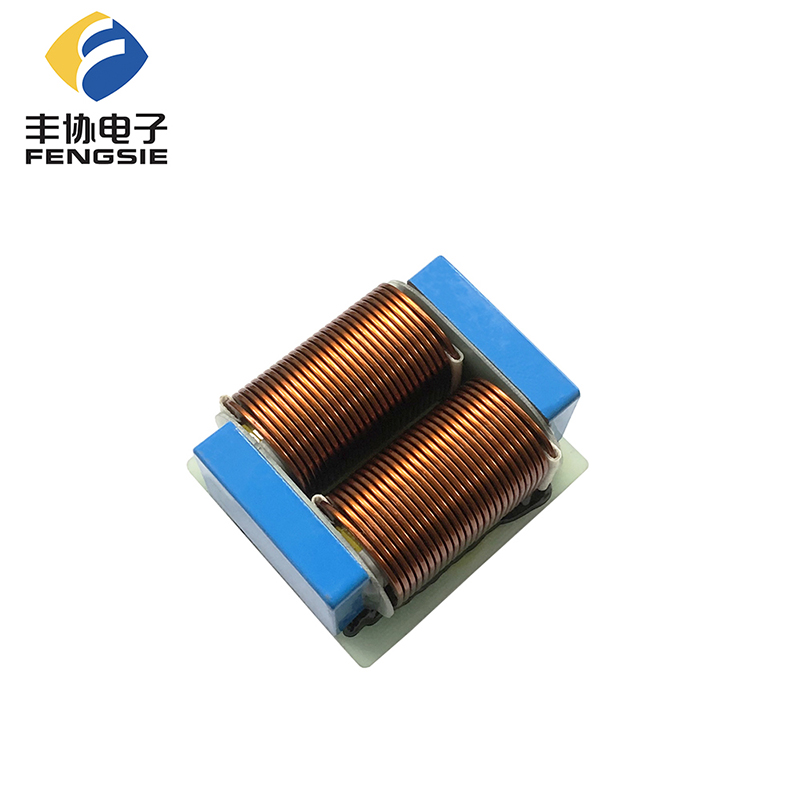
How can energy storage inductors maintain linear stability of inductance value under transient overload conditions through optimized core structure design?
Publish Time: 2026-03-09
In modern power electronic systems and new energy equipment, energy storage inductors play a crucial role in stabilizing current, suppressing current fluctuations, and storing magnetic energy. However, in actual operation, circuits may experience transient overloads or high current surges, causing the magnetic core to rapidly approach or enter a saturation state. Once the core saturates, the inductance value drops significantly, weakening the inductor's energy storage capacity and even leading to current spikes and system instability. Maintaining linear stability of inductance value under high current and transient overload conditions through optimized core structure design has become an important technical direction for improving the performance of energy storage inductors. Through reasonable selection of core materials, structural optimization, and winding design, the stability of the inductor under complex operating conditions can be significantly improved, enhancing the reliability of the entire system.1. Optimizing Core Materials to Improve Saturation ResistanceIn energy storage inductor design, the performance of the core material directly affects the inductor's operating stability. Magnetic materials with high saturation flux density can maintain stable magnetization characteristics under higher current conditions, thus delaying the core from entering saturation. For example, in some high-power inductor structures, common magnetic energy storage inductors use high-performance magnetic materials to maintain a stable inductance value even under high load environments. Appropriate material selection can effectively improve the safety margin of energy storage inductors under instantaneous overload conditions.2. Increasing the core cross-sectional area to reduce flux densityIn terms of structural design, increasing the core cross-sectional area is one of the important methods to prevent core saturation. When the core cross-sectional area increases, the flux density per unit area decreases, thereby reducing the risk of magnetic saturation. In high-power applications, such as high-power choke coil storage devices, larger core structures are typically used to ensure that the inductor can maintain a stable magnetic energy storage capacity even when operating at high currents. This structural optimization not only improves the inductor's energy storage capacity but also effectively reduces fluctuations in inductance value.3. Optimizing winding structure to improve current carrying capacityWinding design is also an important factor affecting inductor stability. Traditional round conductors tend to exhibit high resistance and temperature rise under high current conditions, while using flat copper wire structures can significantly improve the conductor's current carrying capacity. For example, flat wire coil energy storage and copper flat wire energy coil structures typically employ large-section flat copper wire, resulting in a more uniform current distribution, thereby reducing losses and improving heat dissipation efficiency. Simultaneously, edgewise winding storage allows the flat copper wire to be arranged more densely within the magnetic core window, further improving the overall efficiency of the inductor.4. Multilayer Coil Structure Enhances Energy Storage CapacityTo improve energy storage capacity and inductance stability, some high-performance inductors employ multilayer coil structures. For example, multilayer coil energy systems use multilayer winding designs to achieve a more uniform magnetic field distribution, thereby improving energy storage efficiency. In this structure, the magnetic fields between the coils cooperate, enabling the inductor to maintain a stable inductance value over a wide current range. This design is widely used in inductor coil power storage systems, effectively improving the inductor's energy storage performance and stability.5. Advanced Energy Storage Technologies Enhance System PerformanceIn more advanced energy storage technologies, superconducting coils are also being used in magnetic energy storage systems. For example, Superconducting Coil SMES (Superconducting Magnetic Energy Storage System) utilizes the near-zero resistance of superconducting materials to achieve efficient energy storage under extremely high current conditions. Simultaneously, some systems employ Toroidal Superconducting Coil structures to reduce magnetic field leakage and improve system efficiency. While these technologies are primarily used in large-scale energy systems, their design principles also provide important references for high-performance energy storage inductors.Under instantaneous overload conditions, energy storage inductors can maintain linear stability of inductance values through various methods, such as selecting high-saturation core materials, increasing the core cross-sectional area, optimizing flat copper wire winding structures, and using multi-layer coil designs. Furthermore, combining high-current flat wire energy storage structure designs with advanced energy storage technologies can further enhance the inductor's energy storage capacity and system reliability.