Which one will you choose?
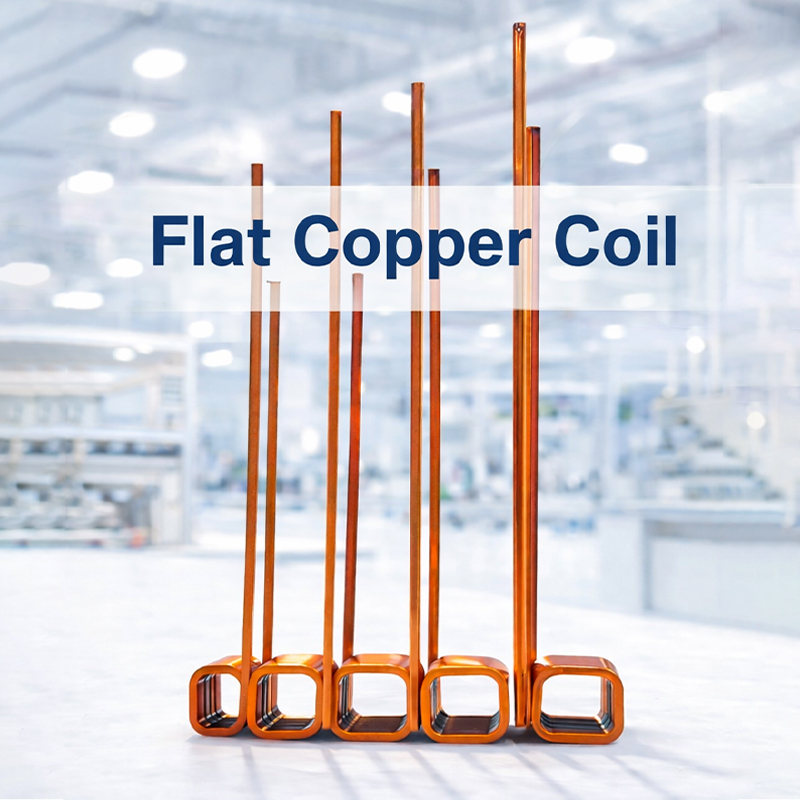
A Technical Perspective on Efficiency, AC Loss, and Power Density.
In high-performance power electronics, the choice between round and flat copper wire is fundamentally an electromagnetic and thermal optimization problem — not a cosmetic or purely cost-driven decision.
As switching frequencies increase and power density targets tighten (EV, AI servers, high-efficiency PFC), conductor geometry directly influences loss mechanisms, thermal limits, and magnetic integration.
DC Resistance & Copper Utilization
Flat copper wire enables significantly higher window fill factor (up to ~90%) compared to round wire (~60–70%).
Engineering implications:
1.Lower DCR for the same window size
2.Reduced copper loss at high current (>20A)
3.Higher current density within thermal limits
4.Fewer winding layers → potentially lower leakage inductance
In high-current PFC inductors and energy storage chokes, DCR often becomes the dominant loss term — making flat conductors structurally advantageous.
AC Loss Behavior (Skin & Proximity Effect)
At frequencies above ~100kHz, AC resistance rise becomes critical.
Round wire limitations:
1.Radial current crowding
2.Increased effective resistance as skin depth decreases
3.Poor utilization of conductor core area
Flat wire advantages:
1.Conductor thickness can be optimized relative to skin depth
2.Improved current distribution across width
3.Reduced proximity loss when properly layered
For high-frequency applications (LLC, OBC, high-density DC-DC), flat conductors provide more predictable AC loss scaling.
However, at very high frequency (>300–500kHz), Litz constructions may still outperform both.
Selection Guidelines (Engineering-Oriented)
Flat copper wire is technically justified when:
1.Switching frequency >100kHz
2.RMS current >20A
3.Volume or height is constrained
4.Efficiency targets are aggressive
5.Thermal margin is tight
Round copper wire remains optimal when:
1.Frequency <50kHz
2.Current is moderate
3.Cost sensitivity is high
4.Production flexibility is required
Whether you are looking for high-performance inductors or state-of-the-art winding machinery, we provide specialized solutions across critical sectors:
✅Automotive Electronics: Powering the EV/HEV revolution.
✅Photovoltaic (PV) Inverters: Enhancing solar energy conversion efficiency.
✅Energy Storage Systems (ESS): Reliability for the modern grid.
✅Industrial Power Supplies: Robust performance for mission-critical apps.
✅Humanoid Robotics: High torque density for the future of AI.