Thermal Design Overlooked? How Can Energy Storage Inductors Achieve Efficient Heat Dissipation and Temperature Uniformity?
Publish Time: 2025-12-15
In high-power power electronic systems such as new energy power generation, electric vehicle fast charging, and data center power supplies, energy storage inductors play a crucial role in energy storage, current smoothing, and electromagnetic interference suppression. However, as system power density continues to increase, inductors face severe challenges under high current and even instantaneous overload conditions—not only may the magnetic core fail due to saturation, but more seriously, internal heat accumulation can lead to uncontrolled temperature rise, accelerating insulation aging, causing performance drift, and even catastrophic failures. Therefore, efficient thermal management has gone from an "optional" to a "must-have." How to maintain a low temperature and uniform temperature field in energy storage inductors under full load operation has become a core issue in high-end product design.I. Starting with the "Heat Source": Precisely Controlling Loss GenerationTo solve the heat dissipation problem, the heat source itself must first be reduced. In high-current applications, winding copper losses are the main heat source. Traditional round wire windings are affected by the skin effect at high frequencies, resulting in a sharp reduction in effective conductive area and a dramatic increase in resistance. Therefore, modern high-performance inductors commonly employ Copper Flat Wire Energy Coil technology. The flat cross-section not only increases the conductor surface area and reduces AC resistance, but its regular arrangement also improves the winding fill factor, reducing thermal resistance caused by gaps. This High Current Flat Wire Energy design allows the inductor to maintain a low temperature rise even when carrying hundreds of amperes of current, laying the foundation for subsequent heat dissipation.
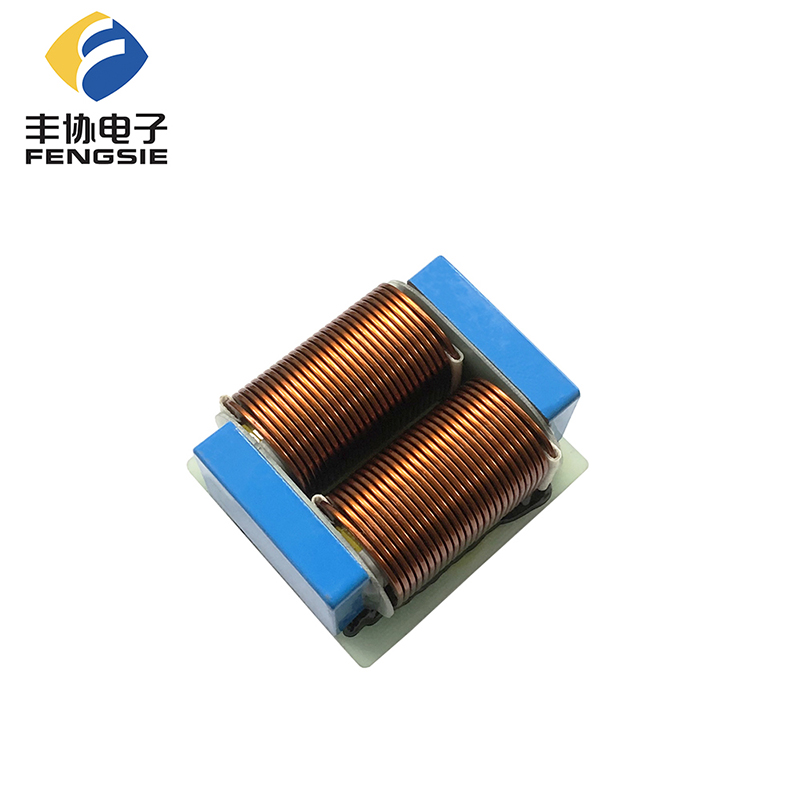

Meanwhile, the choice of core material is crucial. Under high DC bias, ordinary ferrite is prone to saturation, causing a sharp drop in inductance and subsequent current spikes. We select metal powder cores or nanocrystalline materials with high saturation flux density to ensure that the inductor remains linear even under a 20% overload of the rated current, avoiding abnormal heating caused by saturation.II. Structural Innovation: Constructing a "Three-Dimensional Heat Conducting Network"Simply reducing heat generation is not enough; rapid heat dissipation is also necessary. A major advantage of the Flat Wire Coil Energy Storage structure lies in its geometric regularity—multiple layers of flat wires are tightly stacked, forming a near-solid heat conductor. Heat can be conducted laterally along the copper wires to the edges, and then transferred to the casing or heat sink through the interface material.Building on this, the Multilayer Coil Energy System further optimizes the heat path: by using staggered wiring, embedded thermal pads, or microchannels between layers, it guides heat from the central area outwards, breaking the traditional "hot center, cold edge" dilemma. Some high-end High Power Choke Coil Storage products even integrate the magnetic core and aluminum alloy base into a single die-cast design, achieving a triple synergy of magnetism, heat, and structure, reducing thermal resistance by more than 40%.III. Beyond Passive Cooling: Active Cooling and Intelligent MonitoringFor extremely high-power scenarios, passive cooling is no longer sufficient. At this point, system-level thermal management intervenes:Integrating heat sink fins into the inductor casing, combined with forced air cooling;Or embedding a liquid cooling plate at the bottom of the module to directly remove heat;Further cutting-edge solutions explore the use of Toroidal Superconducting Coil in special applications, requiring low-temperature environments but achieving near-zero-loss operation.In addition, intelligent monitoring is becoming a new trend. Embedding miniature NTC or fiber optic temperature sensors within the Inductor Coil Power Storage provides real-time feedback on hotspot temperatures, enabling coordinated load adjustments or cooling activation with the main control system, achieving "predictive thermal management."IV. Simulation-Driven Design: Closed-Loop Verification from Virtual to RealityAdvanced thermal design relies heavily on multiphysics simulation. Engineers utilize electromagnetic-thermal-fluid coupling models to simulate the temperature distribution of inductors under combined conditions such as continuous full load, pulse overload, and high-temperature environments. By adjusting parameters such as the number of winding layers, core window size, and thermal conductivity of the potting compound in the High Power Choke Coil Storage, the optimal thermal performance is found. Subsequently, infrared thermal imaging verification ensures that the temperature rise of the hotspot does not exceed the insulation class limit, and the overall temperature difference is controlled within 10–15°C, truly achieving "temperature uniformity."V. Emphasis on Green, Integrated, and Reliable TechnologyWhile the Inductor Conducting Coil SMES theoretically possesses extremely high energy efficiency, its high cooling costs and complex systems limit its widespread adoption. In contrast, energy storage inductors based on room-temperature copper flat wires and advanced magnetic cores offer advantages in cost, reliability, and engineering feasibility, making them the mainstream direction for the present and the next decade.The thermal design of energy storage inductors is a delicate battle against the "invisible enemy"—heat. By reducing source losses through copper flat wire energy coils, optimizing heat conduction paths with multilayer coil energy systems, and supplementing with active cooling and intelligent monitoring, modern high-reliability inductors can easily withstand the multiple challenges of high current, high frequency, and high ambient temperature. When every watt of loss is precisely controlled and every degree of temperature rise is effectively managed, the energy storage inductor is no longer a "thermal bottleneck" of the system, but becomes a solid foundation for the stable operation of high-power electronic systems.